Showing posts with label traditional. Show all posts

Wednesday, June 26, 2013

육개장 YukGaeJang

Heyyyy dere sexy peoples.

It's been a really long time since I have posted a blog :/ I have been busy with finals for uni and completing assignments so there hasn't been any post for a really long time :( BUT I finished all of my exams yesterday, so I'm not back with a recipe. I'm going to be on break until August so I'll probably try and do a post a week, possible more sometimes.

I hope that you have all been well ~~~

Let's see how we are going in terms of seasons, it's now summer in Korea, so we probably want some summer food right? Even though it is not the hottest time of the year just yet, this dish can still be something that you can enjoy to help cool you down. And it is also great for the colder countries in the southern hemisphere where it is winter at the moment,

The dish for today is called yukgaejang (육개장). It is a spicy soup-like dish that is made with beef and scallions as well as other ingredients such as bean sprouts (kong namuel), bracken, taro stem, onion and dangmyeon (sweet potato noodles). It is usually served with rice and kimchi.

The dish can also be made using chicken, and in that case it could be called dak yukgaejang.

This is a hot spicy dish so you may be confused about why it would be eaten in the summer. Western cultures tend to eat cold foods to cool down in the summer, this cools you down from the inside. However in Korea, they also like to cool themselves down from the outside by eating hot spicy foods to sweat more and thus also be cooled that way.

Ingredients
600g beef brisket
1 small onion
100g bean sprouts
50g taro stem (found dried in Asian marts)
50g bracken (found dried in Asian marts)
3 green onions
1/2 korean radish
3 tbs chilli flakes (gochugaru)
2 tbs minced garlic
3tbs soy sauce
60ml sesame oil
60ml vegetable oil
3tbs salt
1tbs pepper
4L water

Method
1. Soak the taro stem and bracken in warm water for an hour.
2. In a large pot add beef, onion, green onions and all the water. Boil it for 30min on a medium heat with the lid on.
3. Blanch the soaked taro stems and bracken in water for about 10 minutes. Squeeze all the water out and then cut into 10cm pieces.
4. Cut the radish into 1cm pieces
5. Remove the cooked beef from the broth and let it cool for 30 min. After that, tear the beef into small strips.
6. In a bowl mix half the chilli flakes, with 3 tbs sesame oil, soy sauce, garlic, 1tbs salt and the pepper. If you want you can add more chilli flakes.
7. Add the bracken, taro stem and meat in a bowl with half of the sauce and let it sit for 10 minutes.
8. Add the sauce mixture into the broth with the radish and boil it for 40min on a medium heat.
9. In a small pot add all the remaining oil and chilli flakes and stir fry for 2 minutes, constantly stirring to prevent burning.
10. Strain the chilli oil through a cheesecloth.
11. Add some more green onions, bean sprouts, rest of the spicy sauce and chilli oil to the broth and salt to season. Boil for another 10 minutes.
12. Serve with rice and kimchi.

And there you have it, a nutritious dish to eat in summer or winter to cool you down or to warm you up. Either way it is bound to satisfy you.
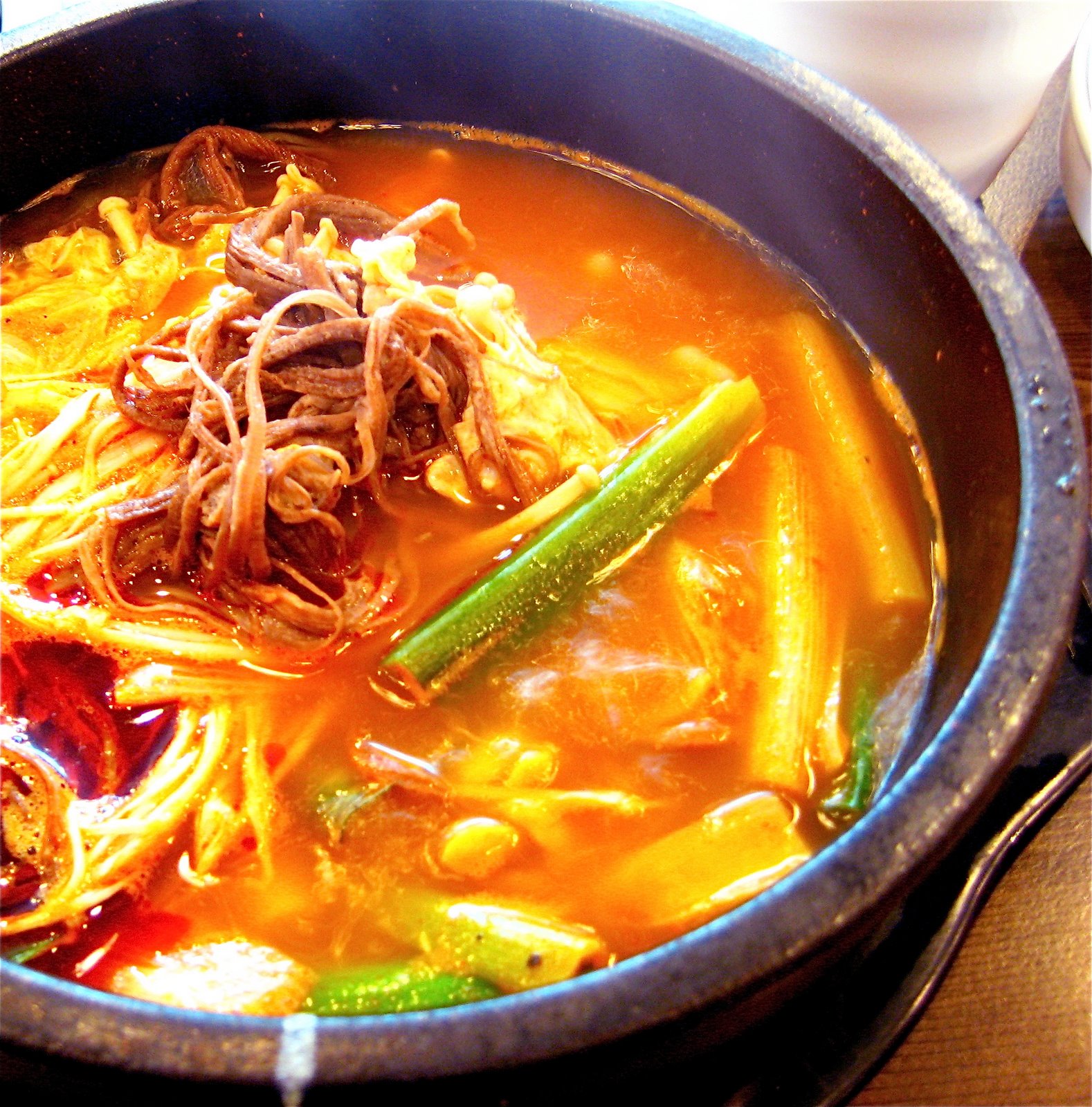


I hope that you like that dish because it is certainly what I'm going to have for dinner tonight as it is super-duper cold and rainy at the moment. Have a try of it when it is super hot or cold and you will feel the heat of the dish radiate throughout the rest of your body.

I'm going to post more in the coming days, and until then remember to keep warm, safe, healthy and happy!

Tuesday, October 30, 2012

Traditional Ginger Cookies 매작과 Maejakgwa

Hey guys, I'm sorry that I didn't post again on Sunday. I couldn't find the time to :(

But I'm back today ant I also have some news that I want to share with you guys. But first of all I will get into the recipe.

So today I thought that I would have a post on a Korean dessert because it seems that it has been a while since I last posted a Korean dessert. So today the dessert that I am going to be introducing you to is called ginger cookies or 매작과(maejakgwa)

The cookies are a traditional Korean cookie that’s really popular. It is a variety of hahngwa, or Korean traditional confection, consisting of wheat flour, vegetable oil, cinnamon, ginger juice, jocheong, and pine nuts. It is also categorized as a form of yumilgwa. You may remember that I have also posted recipes for other traditional Korean desserts that are in the same category. You can find it here: Yugwa

The ingredients are very simple yet the flavour that you get in the end is AMAZING. The best thing about this cookie is that it’s very crunchy! So without any more talking let's get into the recipe:

Ingredients
2 cups flour
1/2 teaspoon salt
1 tablespoon sugar
1 tablespoon gingerjuice
2 tablespoons pine nuts
1/2 cup water
cinnamon powder
vegetable oil

Method
1. In a large stainless steel bowl place the flour, salt, sugar, ginger juice and water and knead it for 20 minutes. OR you can use a food processor for about 2 minutes.
2.Put the cookie dough in a plastic bag and set it aside at least for 30 minutes.
3. Chop pine nuts to garnish the cookies. Set aside.
4. Take the dough out from the plastic bag and roll it out with a rolling pin, into a roughly rectangular shape (about 50 cm x 40 cm, and 2 mm – or 1/16 inch - thick).
5. Cut sheets of cookie dough into 2cm x 6cm rectangles
6. Put the leftover dough edges into a plastic bag to protect them from drying out.
7. Make 3 slits in the middle of each piece of dough.
8. Push one end of the dough through the centre slit to make a ribbon shape
9. Take the leftover dough out and spread it on the cutting board with the rolling pin. Cut it into any of your favorite shapes: triangles, squares, whatever – or use a cookie cutter.
10. Heat up vegetable oil in a wok or frying pan. *tip: Put a sample of the cookie dough into the heated oil to check if it’s the right temperature. The dough should float slowly on the surface of the heated oil.

For the syrup -->
1. Place ½ cup sugar and ½ cup water into a pot and bring to a boil over low heat for about 20 minutes. About half of the water should evaporate, so the syrup is nice and thick.
2. Turn the heat off and add 1 ts cinnamon powder and stir it well.
3. Gently toss the cookies with the syrup to lightly coat them.
4. Sprinkle with chopped pine nuts whist the syrup hasn't set.

And there you have it, a crunchy traditional Korean dessert that you can serve any time. When you have guests over or even when you feel peckish.


I hope that you guys enjoyed that recipe, because I really do absolutely LOVE it.

And now to the news that I had to share with you guys. Because I will be finished with exams after early next week I have decided that I will start a YouTube channel where I can also post up videos of the recipes that I post on this blog. I probably won't get started cooking until a few weeks later, I have't even decided on a name for the channel just yet. But When I do have it all up and running I will put a link to it all here on this blog. 

So that is it from me today. I don't think I will be posting again till the weekend after my exam on Friday. I hope that is ok with you guys. And until then please remember to stay safe, healthy and most important of all happy :)

Friday, August 24, 2012

Sweet Rice Dessert 약식 Yaksik

Hey guys, so I'm back with a recipe this week. School has been getting more hectic since there is so much that I still need to so before I graduate. Anyways to get my mind off all of that I'm going to post a quick blog post today.

Today I will be introducing you to a traditional Korean dessert that is thought to have slightly medicinal properties because of it's ingredients. The dish is called Yaksik 약식. It is a sweet Korean dish made by steaming glutinous rice, and mixing with chestnuts, jujubes, and pine nuts. It is seasoned with honey or brown sugar, sesame oil, soy sauce, and sometimes cinnamon.

Traditionally it is eaten on Jeongwol Daeboreum (정월대보름), a Korean holiday which falls on every 15 January in the lunar calendar, but also for weddings and hwangap festivities. But it is still really nice to have all year around, why wait for the festivities?

Yaksik got its name due to the use of honey in its ingredients. According to the etymology book Ah'un Gakbi (hangul:아언각비, hanja:雅言覺非) written in early 19th century Joseon, it is noted that honey was commonly called as yak (medicine). Thus honey buckwheat wine was called yakju (약주), honey rice was called yakban (약반, old word for yaksik), and fried honey ricecake was called yakgwa (약과).

Records of yaksik date back to Samguk Yusa, written in the 13th century. Legend says that King Soji of Silla headed on a journey on the 15th of January, when a crow alerted him of danger. The King saved himself from a potential revolt thanks to the crow's warning and the day of January 15 was designated as a day of remembrance thereafter. Glutinous rice was put up as an offering during the commemorative rites, which became the origin of yaksik.

The adding of pine nuts, chestnuts, red dates, honey, and oil were added in the Goryeo era. Yaksik is also mentioned in various books from the Joseon period such as Dongguk Sesigi(동국세시기), Yeolyang Seisigi(열양세시기), Dong'guk Yeoji Seungram (동국여지승람). In Yeolyang Seisigi, it is said that envoys to China shared yaksik with the people in Yeonkyung, and most enjoyed the dish.

It's has been a while since I have done a history post of the dishes that I am going to post about, but I think I can get used to it....

And now, to move on to the recipe. There is a bit of work involved but the reward is much greater.

Ingredients
4 C sweet rice
2 C water
(1 1/3 to 1 1/2 C sugar + 3 T honey) OR (1 1/2 C dark brown sugar)
4 T soy sauce
4 T sesame oil
1/2 tsp salt
1 tsp cinnamon powder (optional)
1 1/2 C peeled chestnuts (uncooked and it can be from a can or fresh)
1 C dried jujubes (aka dried red dates)
2 T pine nuts

You need: a pressure cooker (pressure rice cooker works best), 8×8 cake pan or 12 or more cupcake liners or remekins.

Method
1. Measure the sweet rice and soak in cold water for 1 hour (soak 5 hours if you are cooking in the microwave instead of a pressure cooker).
2. Measure and prepare the pine nuts, chestnuts and jujubes. Drain the syrup from the canned chestnuts and set aside. Canned chestnuts work best but you can also use uncooked peeled chestnuts.
3. Wash the dried jujubes, making sure the dust in between the wrinkles are completely washed away. Dry them with a towel. If they are seeded, cut around the seed. If they are seedless, one less thing to do! Cut the flesh into small squares (1/2 inch) or strips.
4. Save the seeds and make some jujube water by boiling and then simmering the seeds in 2 cups of water for 10 min. Now you have jujube tea (대추차 daechucha) which you can drink with some honey and also use some to cook the rice later. Jujube water adds much more flavor.
5. After the sweet rice has soaked for an hour, drain the water from the rice. Cook the rice in a pressure rice cooker by adding 2 C of water (use 1/2 C of the jujube water from step 2 if you can) and follow the instructions for cooking regular white rice. If you don’t have a pressure cooker, you can cook the rice in the microwave – add about 1 C of water and cook on high for 10 minutes.
6. When the rice is cooked (the rice will be very sticky but should not be too mushy), add the sugar, soy sauce, sesame oil, salt and cinnamon powder. Mix the rice well but not too much because it will become too starchy. Stir only until the rice is evenly seasoned.
7. Add the jujubes, chestnuts and pine nuts. Fold them into the rice.
8. Put everything back in the pressure cooker and if you have a ‘steam’ option, steam for 20 minutes. If you don’t have a ‘steam’ option, just choose the shortest rice cook time and cook it again.
9. You are ready to serve Yaksik now. Fill a 8×8 cake pan with the Yaksik and let it cool. Once it’s cool to touch, cover it to keep it from drying. Cut it into small squares or 2/3 in thick slices and serve. Again, when it’s cooled, cover with some plastic wrap.

And there you have it a delicious traditional Korean dessert that you can attempt to make this weekend. But I will warn you that it requires a lot of time, so maybe plan ahead which weekend you want to try the dish out.


So that is it from me this week. I hope that you all stay happy, healthy and safe until I post again next time.