Friday, December 9, 2011

Hot Spicy Fish Soup 매운탕

Hey guys, so I am back with another post today. I hope that you guys tried out the Yugwa recipe from the last post, because I did and it turned out quite nice.

It has been quite cold in Korea and where I am lately so I thought that I should post a recipe that is sure to warm you up from the winter chills. Where I am from and in Korean both share an abundance of one type of food, and that is seafood. So today I am going to introduce to you a recipe that is going to use seafood and warm you up.

Today it is going to be just one variety of seafood stew that can be made in winter. It is going to be Hot Spicy Fish Soup or 매운탕. This is mainly more focused on putting fish into a spicy soup that is made more refreshing by the addition of radish and other vegetables such as green onions and chilies.

The origins of the name is that the name is a combination of two words: maeun, which derives from maepda (맵다), meaning "hot and spicy"; and tang, meaning "soup."

The dish itself is quite easy to make if you have prepared all the ingredients beforehand.

Now, for my version of spicy fish soup.

Ingredients
2 trouts whole (12-14 inches)
½ cup radish, thin sliced
2-3 red chilies, cut in slices

3 green onions, cut in a slices
100g tofu, cut into sqaures
6 tbsp gochujang
1 tbsp soy sauce
2 tbsp gochugaru
3 tbsp minced garlic
3 tbsp salt
6 cups water

Method
1. Scale and wash the fish, then verticall
y cut into several pieces.
2. Put water in a pot, start boiling.
3. Add gochujang, gochugaru and soy sauce. Bring to a boil.
4. Add radish, squash, half of chilies, keep cooking on a medium heat for 3-4 minutes.
5. Add fish, tofu and garlic.
6. Heat until fish is completely cooked. Add salt to taste.
7. Add green onions.
8. Cook for another 1-2 minutes.
9. Serve hot with white rice.

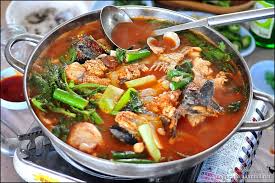


So there you go guys, a nice spicy soup that will be sure to warm you up this winter. And if you like shell fish you can always add them in too to help provide a refreshing taste.

I'll post again soon. Stay healthy and be happy.

Tuesday, December 6, 2011

Yugwa (유과)

So, my exams have finished and to celebrate I'm going to post a dish up. If you look at the time stamp for this post you are probably going to wonder why I am doing this during school hours. It is because I got my wisdom teeth removed yesterday so I'm at home recuperating from it all. And to past time I am writing a post ^^

Today I am going to tell you guys about another Korean dish. It is going to be Korean Hangwa's (한과) or for this post specifically Yumilgwa(유밀과). The name is now more commonly Yugwa (유과) in it's shortened form. I know that these are traditionally eaten at Chuseok, but I just can't wait to share the recipe with you guys. Feel free to try it for next year's festivities.

So the history behind hangwa is that the word has two components: han and gwa.

Gwa means “confectionery”. Sources disagree in their interpretation of han in this word, that is, whether it means “Korean” and whose hanja is 韓 or the one that means “Chinese” and whose hanja is 漢. Most sources, such as several major commercial online dictionaries and encyclopedias, interpret hangwa as “韓菓” (“Korean confectionery”), counterpart of yanggwa (洋果), Western confectionery.

Contrariwise, the internet edition of a standard dictionary by the National Institute of the Korean Language, South Korea's official language regulating body, has “漢菓” (literally “Chinese confectionery”) with a definition that differs from the one given in other sources and this article, calling it a kind of yumilgwa, which is also variety of Korean confectionery, instead of the other way around. This dictionary makes no mention of “韓菓”, whether as an alternative hanja spelling or in a separate entry.


My simplified version of it is that the term "han-gwa" literally means cake or cookie. They are basically cooked with oil and honey and then coated with things like sesame seeds or coconut flakes or thick grains of sugar.

Some are sweeter than others. Some melt in your mouth and others are quite chewy.

Anyway, enough of that. It is time to tell you about the recipe. Today I am going to show you how to make Yugwa because I think that it is the easiest one to make at home.

Ingredients
1 kg of rice cakes (tteok) preferably the tube shaped ones
1 kg of sugar
5 slices of ginger
seasame seeds

Method
1. Roll the rice cakes so that they are flat.
2. Prepare a frying pan and oil for that they tteok can be fried. It is best to have two pans prepared.
3. Set the flame to a medium heat and pour vegetable oil into the pan.
4. When the oil is hot enough place a handful of the rolled tteok into a frying ladle.
5. Fry it until it begins to puff.
6. Transfer it to the next pan and fry until it is golden brown and puffed out. Be careful to not let it burn.If the oil heats up too quickly, you can turn it back down to a low heat.
7. Repeat that for all the tteok.
8. When all the tteok has been fried, set it aside and let the oil drain.
9. To prepare the sugar syrup to coat the tteok, put the sugar and and ample amount of water into a pan. You want enough sugar so that the syrup is not too thick.Place you slices of ginger in at the same time.
10. Let that cook and when all the sugar has dissolved be careful to not let the mixture burn. Turn the heat off when the mixture is ready. Set it aside and let it cool.
11. When the sugar syrup has cooled, and the tteok has had the oil drained, place spoonfuls of the tteok into the syrup and coat it in syrup.
12. When it is coated fish it out and place it into the sesame seeds. Let the tteok be coated in the sesame seeds. Repeat this for the remaining tteok.


And there you have it. A delicious dessert that you can serve during Chuseok and also when you have guests at the house. If you don't want to have ginger flavoured yugwa you can always not put it in.

I hope that you like this recipe, and I'll post another recipe soon. Stay healthy and be happy.

Thursday, December 1, 2011

Yeongyang-dolsotbap 돌솥 비빔밥

오랜만에? It has been a while since I last posted a recipe right?

It is now starting to get cold in SK, and with today it is the official arrival of winter. Although I have not finished exams yet, I really want to make a post to welcome the start of winter.

Today I will be introducing you to a dish that can be eaten in winter to help warm you up, and keep you happy.

"Yeongyang-dolsotbap (돌솥 비빔밥) is a nourishing dish of rice, ginseng, jujubes and chestnuts which are believed to have healing properties. Rice tastes best when cooked in a stone pot because it cooks evenly and stays hot in the pot." Source: Visit Korea Website

It is also known as hot stone pot rice. Basically it is rice that is cooked in a stone pot with vegetables and usually some egg, but today I will be introducing you to a more healthy version of it that involves ginseng and other health goods.

It main problem would probably be finding the pot, especially if you are in a Western country because there just doesn't seem to be many stone pots around.

Anyways, once you have overcome that hurdle the rest of the recipe is quite simple.

Ingredients
360g (2 cups) non-glutinous rice
90g (½ cup) glutinous rice
30g black bean, 60g (4 ea) chestnut, 32g (8 ea) jujube, 37g cultivated pine mushrooms, 24g (12 ea) gingko
10g (1 tbsp) pine nuts
25g ginseng (fresh wet ginseng)
600g (3 cups) water
seasoning sauce : 54g (3 tbsp) soy sauce, 14g (1 tbsp) minced green onion, 5.5g (1 tsp) minced garlic, 1.1g (½ tsp) ground red pepper, 6g (1 tbsp) sesame salt, 0.3g (⅛ tsp) ground black pepper, 8 g (2 tsp) sesame oil

Preparations
1. Wash the non-glutinous rice and glutinous rice cleanly, soak in water for 30 min., drain water on a strainer for 10 min. (non-glutinous rice 440g, glutinous rice 110g).
2. Wash the black bean, soak in water for 3 hours drain water on a strainer for 10 min (63g).
3. Skin the chestnuts, cut into 2~4 pieces. Wipe the jujube with damp cotton cloths, cut the flesh round, divide into 2~3 pieces.
4. Skin the cultivated pine mushrooms, slice it into 0.7cm-thick, maintaining the mushroom shape.
5. Preheat the frying pan and oil, stir-fry the gingko for 2 min. on medium heat with rolling, skin off. Remove tops of pine nuts, wipe the nuts with dry cotton cloths.
6. Wash the ginseng cleanly, remove the head part, cut into 2cm-long and 0.7cm-thick round.
7. Blend seasoning sauce.

Method
1. Put the non-glutinous rice, glutinous rice, black bean, chestnuts, cultivated pine mushrooms, ginseng and water into the stone pot, heat it up for 10min. on high heat. When it boils, continue to boil for another 3 min.
2. Lower the heat to low, add the jujube, gingko and pine nuts, boil it for 10 min. Turn off the heat, steam it for 10 min. for well-done.
3. When the rice is well-done, mix them thoroughly. Put in a bowl and serve with seasoning sauce.


That is it, it really is not that hard and even if you do find it hard think of all the health benefits from this one dish. The ginseng and roots in the dish will help your body fight the cold winter, especially since even Seoul is reaching the minus-degrees.

I hope that with this dish you can all stay health and warm this winter. Take care until my next post, hopefully after Monday when my exams have finished. Fighting!!
건강을 유지하시기 바랍니다!!