Sunday, August 14, 2011

Patbingsoo 팥빙수

It is still quite warm in Korea now (even though I'm in Australia I think anything over 25 is just too hot), so I thought that I would see what summer dish I could think of. I know that I have already done samgyetang and naengmyeon (삼계탕 and 냉면) so I had a little help from the Korean Tourism site.

You all know the name of my blog "PATBINGSOO" but I have never made a post on the actual dish itself. I think it is about time for that, to show you guys one of the most common and popular dishes to have in summer in Korea.

Patbingsoo or 팥빙수 is a popular dish in Korea that is eaten in summer to cool down from the humdity and sweltering weather temperatures. This snack originally began as ice shavings and sweetened azuki beans (known as pat, 팥). It was sold by street vendors.

In contemporary culture, it has become a very elaborate summer dessert, often topped with ice cream or frozen yogurt, sweetened condensed milk, fruit syrups, various fruits such as strawberries, kiwifruit, and bananas, small pieces of tteok (rice cake), chewy jelly bits, and cereal flakes.

That was my introduction for it, but I'll also give you the one offered by the Korean
Tourism Board

"During summer, besides eating ice cream, there’s quite a popular dessert, which Koreans are found eating with friends, families, coworkers, and lovers, called ‘Patbingsu’, which is a big swirl of yogurt or sherbet mounted on some ice and garnished with sweet red beans called ‘Pat’ or fruit. There a various creations and sizes to enjoy with a group or by yourself. The best part of eating this dessert is that you don’t have to worry about calories or watching your weight unlike ice cream. It’s a guilt-free dessert, and one, which is considered a healthy snack.

I highly recommend ‘Green Tea Patbingsu,’ not only is it considered a well-being food, but its shop (
O’sulloc Tea House) specializes only in green tea, making all its food from this ingredient. In the west, ‘green tea’ is still a novelty, which is mostly considered a beverage. It’s a great opportunity to treat two new things- green tea and patbingsu- if you haven’t already. Patbingsu reminds me of a glorified snow cone, but much, much better than a regular snow cone.

Another great franchise to eat fruit bingsu is at a place called “Ice Berry”. It specializes in fruit yogurt desserts with ice and fruit. There is an assortment of different kinds of fruit toppings to choose from such as watermelon, kiwi, peach, strawberry, as well as cereal and vanilla ice cream. If you share with a group of people, it’s best to order a large size bowl called “Jangpan bingsu”. It’s a sumptuous treat to eat in the summer as well.

Tip: Make sure before you eat patbingsu or fruit bingsu, to mix it thoroughly. The taste is much better! Also be careful, don’t just eat the ice by itself. A big spoonful of it may make your brain freeze.
"
[Source: http://visitkorea.or.kr/enu/SI/SI_EN_3_6.jsp?cid=260552 ]


Now you guys should have a wholesome understanding about patbingsoo. Now just so you guys know, what the tourism board says I can't make a comment about the places that it tells you about because I have never been there before...let along heard of it. BUT to put you out of your misery, I'm going to show you my version of patbingsoo.

Seriously, you can eat it however you want and with any combination of toppings. Here goes:

Ingredients
- 2 cups of ice
- 1/2 cup of cut-up fresh fruit (kiwis, strawberries, bananas, pineapple, peaches, mango, any berries, watermelon, melons are all good) or fruit cocktail.
- 1/4 cup of chapsal dduk, sweet rice cake (you can use mochi if you can't anything else)
- 1/3 cup of sweetened canned red bean, called 팥
- 1/4 cup of condensed milk OR scoops of ice-cream <-- I prefer this

You should be able to find everything at your local asian grocer or even supermarket

Method
1. Grind up the ice using a mixer or ice grinder and put it in a bowl (clear bowls are nice to eat out of)

2. Pour the condensed milk or ice-cream over the crushed ice in the bowl. Put the red bean topping over the ice and milk, and then sprinkle the fresh fruit and dduk over the whole thing (you can be artistic and arrange the fruit prettily, or just dump it on top and eat).

3. EAT

The Korean style of eating patbingsoo is 섞어섞어, or "mix mix". You take a spoon, mix everything together so that the toppings and ice blend, and eat! But personally, I prefer leaving the toppings intact until the very end. It is more pretty that way.

That is the recipe for basic patbingsoo...there are a lot of other varieties that you can try, such as green tea patbingsoo and misutgaru patbingsoo (미숫가루 팥빙수)


I hope you guys enjoy that in the summer heat. It looks absolutely delicious....but it is too cold to eat here...maybe I'll just go and have some ice-cream now ^^

Next week = another recipe. Look forward to it

Sunday, August 7, 2011

Hwajeon 화전

Hey guys, here is another dish for this week. I'm kinda sad that I haven't shown you guys a spicy dish in a while. but for the past week I have been having stomach problems so my parents have forbidden me from eating spicy things. Usually I will show you guys what I have eaten, so once again this week it is not spicy.

But something else that I absolutely love is sweet things. So I'm gonna show you guys a sweet Korean dish. This one is quite unique, and I think that it is a really pretty dish. It is not that hard to make, there are only a few steps and if you do it properly it will turn out really nice.

The dish is going to be Hwajeon 화전, or sweet flower pancakes.It is a really great springtime dish to make, which is perfect for those of us in the Southern Hemisphere. I'm sorry for all of you in the Northern part though, I promise there will be something for you later on in this post.

The dish is actually traditionally eaten during hwajeon nori (화전놀이), a traditional custom held since the Goryeo dynasty (918-1392). According to this situation the dish is only eaten in spring, however it can also be eaten in the autumn as long as in-season flowers are used, such as chrysanthemum flowers. However it is then called gukhwajeon (국화전).

I think it about time the history lesson ended and I will start to show you how the dish is made.

Ingredients
Sweet rice flour OR glutinous rice flour
salt
water
sugar
vegetable oil
edible flowers

Method
1. Place 1 cup of sweet rice flour and a pinch of salt in a large bowl.
2. Add ½ cup of hot water little by little. Mix it well with a wooden spoon as you pour in the water.
3. Knead the mixture for 5 minutes.
4. Cut the dough into 12 pieces and roll each piece into a ball.
5. Cover the dough with a wet cloth so it doesn’t dry out. Set it aside.
Make syrup:
6. Place ¼ cup of sugar and ¼ cup of water in a small pot. Simmer over low heat for about 15 minutes, then remove from the heat.
7. Heat up a non-stick frying pan over low heat. Drizzle some vegetable oil on it (½ tbs).
8. Press each rice cake ball into a disc about 5 cm in diameter.
9. Place each disc-shaped rice cake on the pan and cook it.
10. When the bottom of the rice cake is cooked, turn it over to cook the other side. It will take about 3-4 minutes to cook.
*tip: flatten it out on the pan with a spatula to make it larger
11. Place an edible flower on the top of the rice cake, then flip it over so that the flower gets slightly cooked and sticks to the cake.
13. Cook each one and put them on a serving plate.
14. Drizzle the syrup on top of the pancakes.
Serve with green tea or rose tea.

NOTE:
There are a couple of points I want to point out about the dish
- It is important you only cook it right before serving
- Be careful about how much oil you use to cook it, it make turn out too oily if you use too much (the hwajeon in the first picture is a bit too oily)


I hope that you guys all enjoy the dish, it does turn out really pretty if you make it right. I hope that you guys have fun making it and eating it. And take care of your bodies because the weather is starting to change.

And now for the Autumn dish that I promised. Next week :) Look forward to it!

Saturday, July 30, 2011

Jap-Chae 잡채

So as promised from last week. Another Korean dish this week.

Today it will be Jap-Chae (잡채). The dish is not that hard to make, and it is nice to be enjoyed in the summer or winter, making it perfect for both sides of the world.

Japchae is a stir-fried dish that combines sweet vermicelli noodles made from the starch of a white sweet potato, thinly slices of beef, and various vegetables. It is usually prepared with carrots, green onion, spinach, shiitake mushrooms and green peppers. Beef may be added as an option but may be left out to be served as a vegetarian dish. The noodles are gray when raw and turn almost translucent when cooked (thus given its popular nickname, glass noodles). When cooked correctly, they retain a chewy texture.

My mum has actually mastered this dish so I had asked hr for the recipe. It is sorta weird though, because I'm not Korean yet my mum knows how to make Korean food. I guess you can call it being multicultural.

Anyways, back to the dish.

Ingredients

12 oz noodle (Dang Myun)
4 oz beef
5 shitake mushrooms or Chinese black mushrooms
1 carrot
1 onion
1 egg
⅓ lbs spinach
5 tbs oil
1 tbs sesame seed oil
2 tbs soy sauce
Salt & black pepper (pinch)
Sesame seed (pinch)
1 tbs minced garlic
1 tbs chopped green onion

Method

1. Soak mushrooms in water for 15 minutes. Cut off stems then cut the caps into thin strips.
2. Cut beef into thin strips and marinate it with the mushrooms in a seasoning of: soy sauce, sugar, minced garlic, sesame seed oil, chopped green onions, and a pinch of ground pepper.
3. Cut carrots and onion into thin strips (julienne).
4. Cook spinach in boiling water for about two minutes. Cool spinach in running water. Squeeze the water out of the spinach. Season the spinach slightly with salt and sesame seed oil.
5. Batter and fry the egg in a pan with a pinch of salt. Once cooked and cooled, cut the egg into thin slices.
6. Cook the noodles in boiling water for about 2-4 minutes or until soft (You may want to cut the noodles in half before hand if they are too long). Rinse in cold water and drain.
7. Start cooking the beef and mushrooms with a bit of oil.
8. When beef is cooked, add carrot, onion, spinach, and noodles and stir-fry.
9. When vegetables are cooked, add the sliced egg and use salt and soy sauce to season the dish to your taste.
10. Put it all in a dish and sprinkle some sesame seeds for the final touch.
Can be served hot or cold.


The dish isn't hard to make. The most trouble you will have may be actually finding the correct type of noodles for the Japchae. The easiest way to find it is to go to your closest Asian grocer and try to look for it, it is probably easier to look for sweet potato vermicelli noodles than for dang myun so I suggest doing that. Also this can be a vegetarian dish by leaving out the meat, so it is easy to accommodate for all eaters.

I hope you guys enjoy that, it is a simple Korean dish that is perfect for those of you who can't handle spicy things.

Another Korean dish next week? I think so (:

Sunday, July 24, 2011

Hotteok 호떡

So I'm suddenly craving hotteok 호떡. You may not know what it is....well it is a popular street food in Korea and is usually eaten in Winter. Which is perfect for now because it is cold.

The dough for hotteok 호떡 is made from wheat flour, water, milk, sugar, and yeast. The dough is allowed to rise for several hours. Handful-sized balls of this stiff dough are filled with a sweet mixture, which may contain brown sugar, honey, chopped peanuts, and cinnamon. The filled dough is then placed on a greased griddle, and pressed flat into a large circle with a special tool with a stainless steel circle and wooden handle as it cooks.

It is sort of like a pancake with fillings...if you want to put it that way. It is apparently best not to indulge in this snack because of its high sugar content...but I have a sweet tooth so it is sort of inevitable that it will happen.

My fingers are getting colder and colder, so I'll move on to giving you guys the recipe for this snack.

Ingredients
2 3/4 – 3 cups all purpose flour
1 tsp baking soda
3/4 tsp salt
1 tbsp sugar
1 cup milk (low fat or full)
Filling
1/4 cup brown sugar
2 tbsp sugar
3/4 tsp ground cinnamon

Method
1. In a large mixing bowl, whisk together 2 1/2 cups flour, baking soda, salt and sugar. Stir in milk and mix until smooth. Gradually add in the remaining flour until dough is very stiff.
2. Turn the dough out onto a floured surface and gently knead until dough is just barely tacky to the touch, and feels fairly smooth and elastic (about 1 minute).
3. Shape dough into a ball, cover it with a clean dish towel and let rest for 15 minutes.
4. In the meantime, combine all filling ingredients in a small bowl and set aside.
5. Once rested, divide the dough into 6 equal pieces.
6. Work with one piece of dough at a time. Roll it out on a lightly floured surface into a circle about 5-6-in. wide. Place 1 tbsp filling in the center of the dough, then bring up the sides and pinch them together around the filling to seal tightly.
7. Roll out the dough ball with filling inside, lightly flouring both the surface and the rolling pin to ensure that nothing sticks and tears open the dough, until you have a disc about 1/4-inch thick. Slightly thicker is ok, but the cake should be quite thin. Repeat with all remaining pieces of dough.
8. Put about 2 tbsp of vegetable oil in a large pan and turn up the heat to medium-high. When oil is hot, place 1 or 2 of the hotteoks (depending on the size of your pan) in the pan and cook until golden brown. Turn once, then cook the second side until it is golden brown as well, about 3-5 minutes overall.
9. Repeat with remaining hotteoks.
Serve hot.


I hope you guys enjoy that snack. And I'll be back with another recipe next week. I promise to make it Korean (:

Monday, July 18, 2011

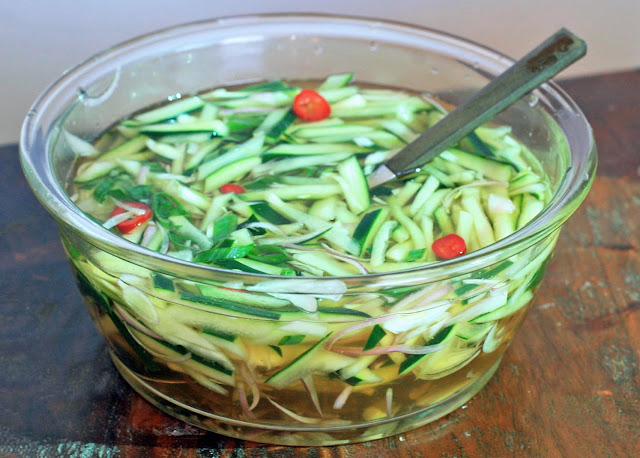
Oi Naengguk 오이 냉국

As promised from yesterday, I have come back today with a dish that is perfect for those of you in the Northern Hemisphere. The dish is bound to be refreshing and cooling in the heat.

Naengguk(냉국) refers to all kinds of cold guk(국) (soups) in Korean cuisine, mainly eaten in summer. It is so called changuk(찬국), which literally means "cold soup" in pure Korean, while the term naengguk is a combination of a hanja word and a pure Korean word with the same meaning.

Naengguk (냉국), which are cold soups generally eaten during the summer months to cool the diner. A light hand is usually used in the seasoning of these soups usually using ganjang and sesame oil

Naengguk (냉국) is largely divided into two categories according to seasoning and ingredients. The first category is made by mixing chilled water and vinegar to give a sour and sweet taste such as miyeok naengguk (미역
냉국) made with wakame, oi naengguk (오이 냉국) made with cucumber, pa naengguk (바냉국) made with spring onions, nameul naengguk (나믈냉국) made with garlic, and gim naengguk (김냉국) made with gim or nori. The other category is made to supplement health and has rich tastes such as chilled soup made with chicken, sesame, or soybeans.

You may find that this recipe is similar to one that I had posted about a year ago on naengmyeon (냉면). 냉면 is a cold noodle dish whilst 오이 냉국 is a cold soup.

I have chosen to do the cucumber soup because it is more easy and cucumber is a vegetable that we are more willing to eat...compared to garlic.

NOW, for the recipe.

Ingredients
* 4 mini cucumbers or 1 regular cucumber, seeded and cut into matchstick strips
* 2 shallots, cut into matchstick strips
* 2 teaspoons sea salt
* 4 Tablespoons rice vinegar
* 3 Tablespoons sugar
* 1 Tablespoon gluten-free soy sauce
* 3 cups cold water
* 1 green onion, sliced into thin rings
* 1 hot red chili pepper, seeded and cut into thin rings
* ice cubes, optional

Method
1. In a large bowl, combine the cucumbers, shallots and salt. Set aside.

2. In a medium bowl, combine the vinegar, sugar, soy sauce and water. Add this mixture to the cucumber.

3. Add the green onions and mix well. Place in the refrigerator until well chilled. Garnish with red pepper rings. Add an ice cube or two in each bowl to keep the soup extra cold, if desired.

Serves three to four.


So there you go, a nice cold dish that is simple to prepare in the hot and humid Korean weather conditions.

I hope you all enjoy that whilst I go and make myself some ddeokbokki because it is cold right now.

Sunday, July 17, 2011

Oh gosh it's DDEOKBOKKI (떡볶이)

Boy, has it been a while since I have been on this blog

I have been so busy with the other aspects of my life that I totally forgot about this blog, if it wasn't because I had remembered a blog I used to follow I think I would have forgotten that I ever created this blog.

Now I'm really sorry for not posting for like the past year(?) but I will start again soon, and hopefully I can make it a habit.

So to start things off again...I think I should tell you about the food I had when I was on holidays back in January. Yes, I know that it was AAAAGGGESSS
SS ago...but better late than never. So I went to Hong Kong and Japan, but what I'm gonna tell you is about something that I had when I was in Hong Kong.

When I was in Hong Kong, I had my first ever Korean BBQ. Now being Australia I'm accustomed to have BBQs but a Korean BBQ is actually quite different from the usual Australian one. For one we don't have it outside and the servings of meat are quite...well small. I knew what a Korean BBQ would be like... but it was the flavours that surprised me.

My family can't really eat spicy, only I can. So I was a bit disappointed that I was unable to experience the authentic Korean BBQ. :( But non-the-less, the food was delicious. I loved the meat and especially the sauces that we could have. The side dishes were all amazing....

I wish I had taken photos...but I didn't so I am reserved to have to use photos from Google images, but I'm sure that you get the same idea.

NOW, to move on to the recipe that I will be telling you about this time. I'm going for Korean because well....I was talking about Korean food just then.

I'm gonna introduce to you guys a dish called ddeokbokki (떡볶이). I know that it is usually labelled as a snack...but when I was in Hong Kong I was fortunate to have the whole dish to myself. I have had it before in Australia as well...and lets just say that it is just one of the Korean dishes that I have fallen in love with.

I love the chewy rice cakes and the spicy gochujang (고추장) paste. Now I'm gonna show you guys how to make two variations of this dish, a spicy version and a more mild version for those of you who can't eat spicy things.

Spicy Ddeokbokki

Ingredients

Tube shaped rice cake (300 grams)

Hot pepper paste [gochujang (고추장)]

Dried anchovies (a must for a tasty dish)

Sugar

Water

Green onions

Directions:

  1. Separate the tubes of rice cake into individual pieces.
  2. In a pan, pour 4 cups of water and add 7 large dried anchovies after removing their heads and intestines. Boil the water for 10 minutes over medium heat.
  3. Remove the anchovies and add the rice cakes, 4-6 tbs of hotpepper paste, 1 tbs of sugar, and 1 tbs of hotpepper flakes (optional). Stir it constantly.
  4. Cut 7 green onions into 5 cm long pieces, and add them to the pot.
  5. Keep stirring until the sauce is thick and the rice cake is shiny.
  6. Transfer it to a plate and serve


Now for the mild version

Mild Ddeokbokki

Ingredients:

1 package of rice cake

Beef strips

Soy sauce

Sugar

Garlic

Onion

King oyster mushrooms

water

Directions:

  1. Saute 200 grams of beef strips with 2 tbs soy sauce, 1 tbs sugar, 2 cloves minced garlic, and 3 tbs of sliced onion.
  2. Add 3-4 sliced king oyster mushrooms and 2 chopped green onions to “1″ and stir it.
  3. Add 1 cup of water and put rice cake in it and keep folding until rice cake is soft
  4. Serve it on a plate and eat it when it is warm

Now, that is my two recipes for ddeokbokki. I hope you guys like it in this wintery weather in Australia...and I'll try and post a recipe for those of you who are in the Northern hemisphere in the summer :D

Saturday, October 2, 2010

Spring Strawberries with honey and vanilla, Moscato d’Asti granita and whipped cream

I am so sorry for not posting, but I have exams and I am busy studying. I’ll post again in …..2 weeks. So this is just a really quick post as well. So, I’m gonna give you the recipe for Spring Strawberries with honey and vanilla, Moscato d’Asti granita and whipped cream.

Ingredients
100ml honey
50ml water
1 vanilla bean
1kg sweet spring strawberries
250ml pure cream
For the grantia:
375ml Mosacto d’Asti
60g caster sugar
375ml water

Method
You need to make the granita a day before you plan to serve it. Combine the Moscato, sugar and all the water in a bowl. Stir well to dissolve the sugar. Pour the mix into a tray. Put it in the freezer overnight to freeze solid. When the granita is required, simply scrape the mixture with a fork to form small ice crystals.

To make the syrup for the strawberries, place the honey, water and the split and scraped vanilla bean in a small pot. Bring the mix to the boil, stirring well. Place the syrup through a fine sieve. Allow the syrup to cool completely.

Hull the strawberries and place them in a bowl. Add the syrup and set aside to marinate for 30 minutes before serving. Whip the cream until soft peaks form and place in the fridge.
To serve, place the strawberries and some of the syrup in individual serving glasses. Add 2tbsp shaved granita and top with a dollop of whipped cream serve immediately.

Do take note that the grantia contains alcohol, so it is not suitable for young children. If you want to make it suitable for children, replace the Moscato d’Asti with strawberry juice.